Jump Training vs Plyometrics: What's the Difference (And Why It Matters)
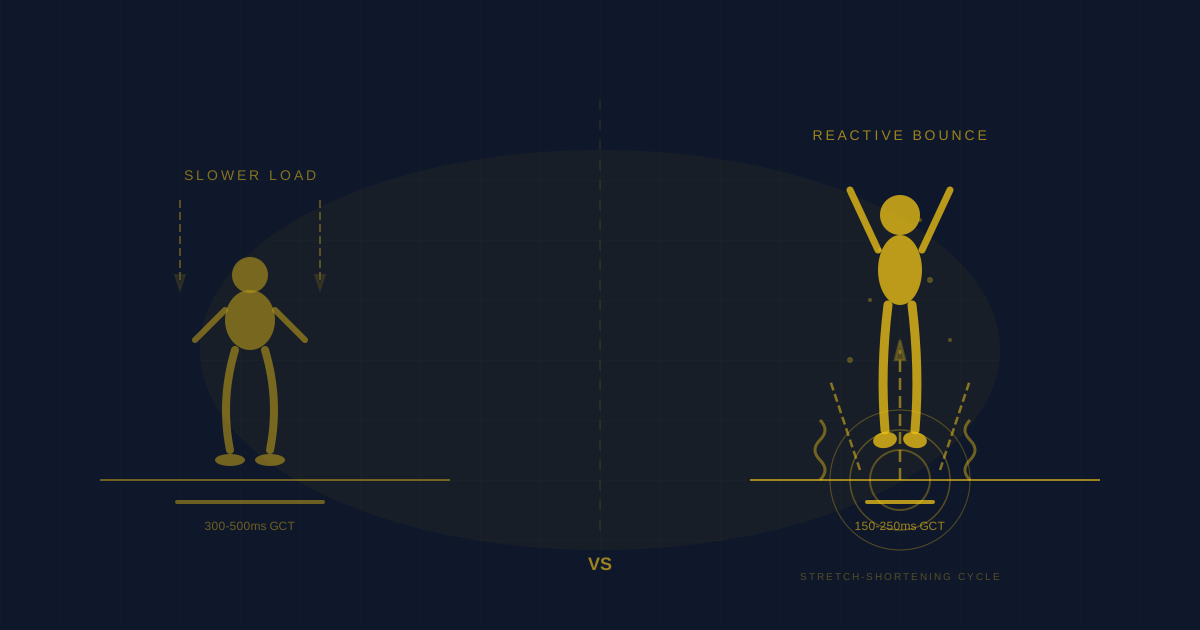
People use “jump training” and “plyometrics” interchangeably. They’re not the same thing—and conflating them is one of the most common mistakes in athletic development.
Every plyometric is a jump. Not every jump is plyometric.
Understanding this distinction changes how you program, how you coach, and how athletes improve. Let’s break it down.
The Simple Definition
Jump training is any exercise where you leave the ground. Box jumps, vertical jumps, broad jumps, hurdle hops—all jumping.
Plyometrics is a specific type of jump training that exploits the stretch-shortening cycle (SSC). It requires rapid eccentric loading followed immediately by explosive concentric action. The key word: rapid.
A depth jump where you drop from a box, spend minimal time on the ground, and explode upward? Plyometric.
A box jump where you pause, set up, and jump at your own pace? Just jumping.
The Stretch-Shortening Cycle Explained
The stretch-shortening cycle is the mechanism that makes plyometrics different from regular jumping.
Here’s what happens during a true plyometric movement:
-
Eccentric phase: Your muscles and tendons lengthen rapidly as you absorb force (landing from a drop, the downward portion of a countermovement).
-
Amortization phase: The brief transition between lengthening and shortening. This is the critical window—it must be short (under 0.25 seconds) for the SSC to work.
-
Concentric phase: Your muscles shorten explosively, propelled by stored elastic energy and neural factors from the rapid stretch.
When the amortization phase is short, elastic energy stored in your tendons during the eccentric phase amplifies the concentric output. Your muscles get a “free” boost on top of their contractile force.
When the amortization phase is long? That stored energy dissipates as heat. You lose the elastic recoil. It’s just a regular jump.
Ground Contact Time: The Defining Variable
Ground contact time (GCT) separates plyometrics from general jump training.
True plyometric exercises have short ground contact times—typically under 250 milliseconds, and often under 200ms for advanced drills.
Plyometric (short GCT):
- Depth jumps: 150-250ms
- Bounding: 120-180ms
- Drop jumps: 100-200ms
- Reactive hurdle hops: 120-160ms
Jump training (longer GCT):
- Box jumps with pause: 400ms+
- Standing vertical jump: 300-500ms
- Countermovement jump: 250-400ms
- Squat jumps: 500ms+
The countermovement jump sits in a gray zone. Fast athletes with good reactive ability can execute it with short GCT and make it plyometric. Most people take too long in the transition.
Why This Distinction Matters for Training
Different training goals require different approaches.
If You Want Maximum Force Production
General jump training and squat jumps—where you can spend more time on the ground and produce maximum force—are better choices. The longer GCT allows full muscle activation.
Best for: Building maximum power output, early-stage athletes, strength-dominant sports.
If You Want Reactive Ability
True plyometrics with short GCT train the stretch-shortening cycle and improve reactive strength. You’re training your tendons as much as your muscles.
Best for: Speed, agility, sport-specific quickness, change of direction, advanced athletes.
If You Want Both
Most programs need both. The mistake is calling everything “plyometrics” and not distinguishing between them.
A well-designed program might include:
- Squat jumps for maximum power development (jump training)
- Box jumps for height/technique work (jump training)
- Depth jumps for reactive strength (plyometrics)
- Bounding for horizontal reactive power (plyometrics)
Labeling matters because programming matters. You can’t load plyometrics the same way you load jump training.
The Reactive Strength Index
The Reactive Strength Index (RSI) quantifies the difference between jumping and plyometrics.
RSI = Jump Height / Ground Contact Time
An athlete who jumps 20 inches with 200ms GCT has an RSI of 2.54. An athlete who jumps 22 inches with 400ms GCT has an RSI of 1.40.
The second athlete jumps higher. The first athlete is more reactive—they’re better at exploiting the stretch-shortening cycle.
Sport demands determine which matters more. A volleyball blocker reacting to a setter needs high RSI. A shot putter gathering force for a single explosive effort can afford longer GCT.
Common Programming Mistakes
Calling Everything Plyometrics
When coaches label box jumps, squat jumps, and slow jumping as “plyometrics,” they misunderstand the training stimulus and program inappropriately.
True plyometrics are high-stress on the nervous system and connective tissue. You can’t do high volume. When you think everything is plyometric, you either:
- Overtrain actual plyometrics by doing too much
- Undertrain reactive ability by not including enough true plyometric work
Ignoring the Amortization Phase
Athletes often pause too long between landing and takeoff, converting a plyometric drill into a regular jump.
Coaching cue: “Spend as little time on the ground as possible.” The floor is lava. Bounce like a ball, don’t squat and jump.
Skipping the Foundation
True plyometrics require a strength base. The eccentric forces during rapid landing are 2-3x bodyweight for basic drills and up to 7x bodyweight for depth jumps from height.
Athletes who lack the strength to absorb those forces can’t perform plyometrics safely. They need jump training first—slower, controlled jumping that builds landing mechanics and eccentric strength.
General guideline: Athletes should be able to squat 1.5x bodyweight before heavy plyometric work. Before that, stick to lower-intensity jump training and focus on landing quality.
How to Make Jump Training More Plyometric
You can shift exercises along the spectrum by manipulating a few variables:
Reduce Ground Contact Time
Cue athletes to minimize time on the ground. Use reactive cues: “bounce,” “pop,” “spring.” Avoid “jump high”—that leads to longer loading times.
Add a Drop
Starting from an elevated surface forces rapid eccentric loading. A hurdle hop becomes more plyometric when you step off a low box first.
Use External Focus
External cues like “push the floor away” or “explode through the ground” promote faster reactions compared to internal cues about muscle activation.
Measure and Feedback
If you can measure ground contact time (some apps and devices do this), give athletes real-time feedback. Nothing changes behavior like seeing your numbers.
The Intensity Spectrum
Think of jump training and plyometrics as a spectrum, not a binary:
Low intensity (jump training):
- Pogo hops
- Line jumps
- Skipping
- Box step-ups with jump
Moderate intensity (transitional):
- Countermovement jumps
- Broad jumps
- Low hurdle hops
- Lateral bounds
High intensity (plyometrics):
- Depth jumps
- Drop jumps
- Single-leg bounds
- Reactive hurdle hops
Very high intensity (advanced plyometrics):
- Altitude drops
- Weighted depth jumps
- Complex training pairs
Program intensity appropriate to the athlete’s training age, strength base, and sport demands.
Practical Programming Guidelines
For Beginners
Focus on jump training. Build landing mechanics, eccentric strength, and movement quality. Include:
- Low box jumps (step down, don’t jump down)
- Broad jumps with reset
- Squat jumps
- Low-intensity hops and skips
Ground contacts per session: 40-60 True plyometrics: Minimal or none
For Intermediate Athletes
Introduce true plyometric work gradually while maintaining jump training. Include:
- Countermovement jumps with emphasis on speed
- Depth jumps from low heights (12-18 inches)
- Bounding
- Reactive hurdle hops
Ground contacts per session: 60-100 Plyometric ratio: 30-40% of total contacts
For Advanced Athletes
Full plyometric programming with periodization. Include:
- Depth jumps from appropriate heights
- Complex training (strength + plyometric pairs)
- Sport-specific reactive drills
- High-intensity bounds and drop jumps
Ground contacts per session: 80-140 Plyometric ratio: 50-70% of total contacts
Testing Both Capacities
Smart programs test both maximum jumping ability and reactive ability:
Maximum jump tests (longer GCT allowed):
- Squat jump (no countermovement)
- Approach vertical jump
- Standing broad jump
Reactive ability tests (minimize GCT):
- Drop jump RSI
- Repeated hop test
- 10-5 repeated jump test
An athlete might score well on maximum jump tests but poorly on reactive tests—or vice versa. The test results reveal which quality needs more training emphasis.
The Bottom Line
Jump training builds jumping ability. Plyometrics builds reactive ability. Both matter. They’re trained differently.
When you call everything “plyometrics,” you program poorly and miss the specific adaptations each type of training creates.
Know what you’re training. Know why you’re training it. The distinction between bouncing off the ground like a spring and loading up for a big jump is the difference between reactive power and maximum power.
Train both. Label them correctly. Program them appropriately.
That’s how athletes get faster, quicker, and more explosive—not just better at jumping.
Ready to build explosive power?
Start planning your plyometric training today. Free for athletes.
Get Started FreePlyoPlanner Team
Helping coaches and athletes train smarter