5 Metrics Every Plyometric Athlete Should Track
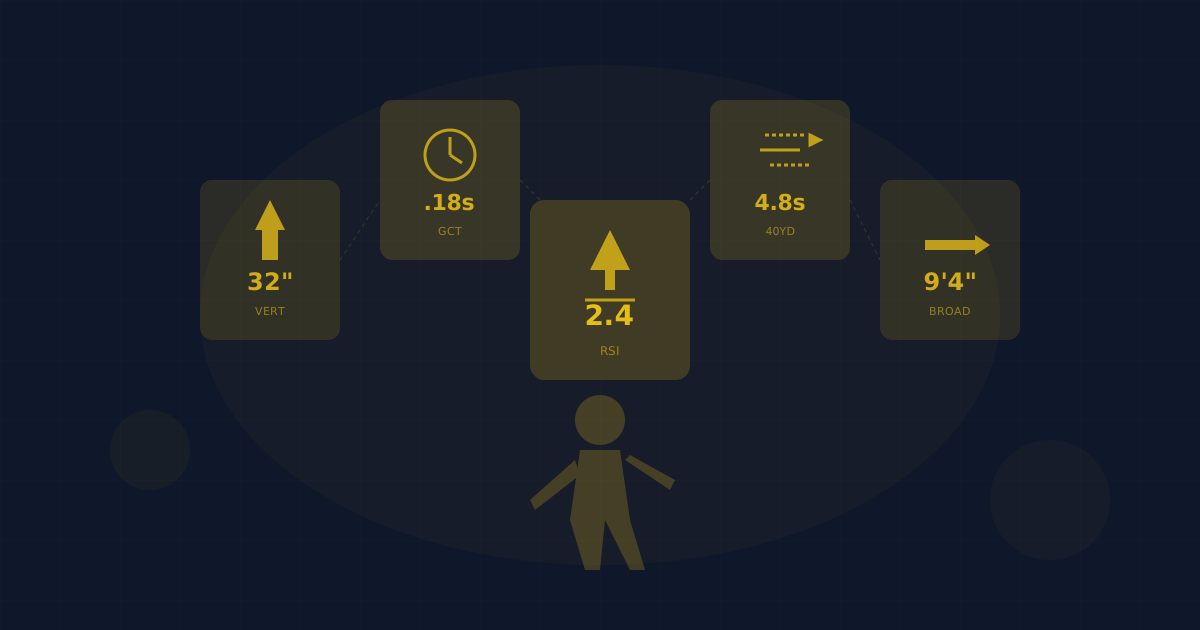
You’re training hard. Jumping, bounding, pushing yourself through every session. But here’s the uncomfortable question: are you actually getting better?
Without objective measurements, you’re guessing. And guessing doesn’t win games, earn scholarships, or break personal records.
The solution is simple: track the right metrics. Not everything—just the metrics that actually matter for explosive athletic performance. Here are the five every plyometric athlete needs to measure.
1. Vertical Jump
The vertical jump is the gold standard of explosive power testing. It’s been used by coaches, scouts, and researchers for decades because it tells you exactly what plyometric training is supposed to improve: how high you can get off the ground.
How to Test
Standing Vertical Jump:
- Stand next to a wall or under a Vertec device
- Reach up and mark your standing reach height
- Jump as high as possible, marking your peak height
- Vertical jump = peak height minus standing reach
Approach Vertical Jump:
- Same setup, but take 2-3 steps before jumping
- More sport-specific for basketball, volleyball players
What the Numbers Mean
For reference, here are general benchmarks for male athletes (subtract 4-6 inches for female athletes):
- Below average: Under 16 inches
- Average: 16-20 inches
- Good: 20-24 inches
- Excellent: 24-28 inches
- Elite: 28+ inches
Testing Frequency
Test your vertical jump every 4-6 weeks. More frequent testing creates noise from daily performance variation. Less frequent testing means you’re flying blind for too long.
Record both your standing and approach jumps. Some athletes improve their approach technique faster than their raw power—tracking both tells the full story.
2. Broad Jump (Standing Long Jump)
While the vertical jump measures upward explosion, the broad jump tests horizontal power. This matters for sprinters, football players, soccer players—anyone who needs to drive forward explosively.
The broad jump also requires excellent coordination between your arms and legs, making it a test of total-body power production.
How to Test
- Stand with toes behind a starting line
- Swing arms and jump forward as far as possible
- Land on both feet (the landing must be controlled)
- Measure from the starting line to the back of your heels
What the Numbers Mean
Adult male benchmarks:
- Below average: Under 6 feet
- Average: 6-7 feet
- Good: 7-8 feet
- Excellent: 8-9 feet
- Elite: 9+ feet
Subtract approximately 1-1.5 feet for female athletes.
Why It Complements Vertical Jump
Some athletes have excellent vertical jumps but mediocre broad jumps (or vice versa). This reveals something about their power production patterns:
- High vertical, low broad jump: Strong at vertical force production, may need horizontal power work
- High broad jump, low vertical: Good horizontal drive, may need more reactive/vertical training
Tracking both gives you a complete picture of explosive capability.
3. Sprint Times (10, 20, 40 yards)
Speed is the ultimate expression of power. If you can’t sprint fast, you can’t play fast—regardless of how high you jump in a controlled testing environment.
The beauty of sprint testing is it’s directly applicable to sport. Every major sport involves sprinting, whether it’s chasing a ball, covering a receiver, or breaking away from a defender.
How to Test
Use electronic timing gates if possible. If not, a training partner with a stopwatch works (just be consistent with who times and how).
10-Yard Sprint: Tests acceleration from a standstill. Critical for basketball, football linemen, tennis players—anyone who needs to move quickly from rest.
20-Yard Sprint: Measures acceleration plus early top-speed development. Common testing distance for many sports.
40-Yard Dash: The combine classic. Tests full acceleration and speed maintenance. Most relevant for football, but useful for any field sport athlete.
What the Numbers Mean
40-yard dash benchmarks for male athletes:
- Below average: Over 5.2 seconds
- Average: 5.0-5.2 seconds
- Good: 4.7-5.0 seconds
- Excellent: 4.5-4.7 seconds
- Elite: Under 4.5 seconds
Female athletes typically run 0.4-0.6 seconds slower at equivalent training levels.
Testing Tips
- Test on the same surface each time (track, turf, court)
- Standardize your starting position
- Take 3 attempts, record the best
- Ensure full recovery (3-5 minutes) between attempts
4. Reactive Strength Index (RSI)
Here’s where we get into the metric that separates elite plyometric athletes from everyone else.
Reactive Strength Index measures how well you use the stretch-shortening cycle—the rapid stretch and contraction that makes plyometrics so powerful. It’s not just about how high you jump, but how quickly you can reverse direction and explode.
How to Test
RSI is calculated from drop jump performance:
- Step off a box (typically 12-18 inches)
- Upon landing, immediately jump as high as possible
- RSI = Jump Height ÷ Ground Contact Time
You’ll need a contact mat, force plate, or video analysis to measure ground contact time accurately.
What the Numbers Mean
RSI is expressed as a ratio (meters per second or feet per second):
- Low: Under 1.5
- Moderate: 1.5-2.0
- Good: 2.0-2.5
- Excellent: 2.5-3.0
- Elite: Over 3.0
Why RSI Matters
RSI captures something neither vertical jump nor sprint times can: your ability to be reactive.
An athlete with a 30-inch vertical might have a poor RSI if they need a long, deep countermovement to jump that high. In game situations, you rarely have time for that long wind-up.
RSI identifies athletes who can produce force rapidly—the ones who are quick, not just powerful.
Improving RSI
If your vertical jump is good but RSI is poor:
- Focus on shorter ground contact times during training
- Emphasize depth jumps and drop jumps
- Cue “stiff” landings that minimize knee bend
If your RSI is good but vertical jump is poor:
- You’re reactive but need more raw power
- Emphasize squat jumps, loaded jumps, strength training
5. Ground Contact Time
Ground contact time (GCT) measures how long your foot spends on the ground during running, jumping, or bounding. It’s one component of RSI, but valuable to track on its own.
Elite sprinters have ground contact times around 0.08-0.10 seconds. Recreational athletes might be 0.15-0.20 seconds or longer. That difference—fractions of a second—translates to significant speed differences over 40 yards.
How to Test
Ground contact time requires either:
- Contact mats or force plates
- High-speed video analysis (240+ fps)
- Specialized apps using phone cameras
The most accessible method for most athletes is testing during drop jumps (same setup as RSI testing).
What the Numbers Mean
Drop jump ground contact time benchmarks:
- Long: Over 0.30 seconds
- Moderate: 0.25-0.30 seconds
- Short: 0.20-0.25 seconds
- Very short: 0.15-0.20 seconds
- Elite: Under 0.15 seconds
The Training Connection
Ground contact time improves through:
- Reactive plyometrics (depth jumps, drop jumps)
- Stiffness drills (ankle hops, line hops)
- Cueing “quick” rather than “high” during training
Athletes often focus entirely on jump height when they should be thinking about getting off the ground faster.
Putting It All Together
These five metrics create a complete picture of explosive athletic performance:
| Metric | What It Tests | Test Frequency |
|---|---|---|
| Vertical Jump | Pure vertical power | Every 4-6 weeks |
| Broad Jump | Horizontal power | Every 4-6 weeks |
| Sprint Times | Speed application | Every 4-6 weeks |
| RSI | Reactive ability | Every 4-6 weeks |
| Ground Contact Time | Stiffness/reactivity | Every 4-6 weeks |
Track all five and you’ll know:
- If you’re getting more powerful (vertical/broad jumps improving)
- If power is transferring to speed (sprint times dropping)
- If you’re becoming more reactive (RSI and GCT improving)
How to Start Tracking
Step one: test everything this week. Get your baseline numbers.
Step two: log them somewhere you’ll actually look at. A notebook, a spreadsheet, or—better yet—an app built for athletic performance tracking.
Step three: retest every 4-6 weeks. Compare to previous numbers. Celebrate PRs.
The athletes who improve fastest are the ones who measure consistently. They don’t wonder if training is working—they know.
Start tracking. Start improving. The numbers don’t lie.
Ready to build explosive power?
Start planning your plyometric training today. Free for athletes.
Get Started FreePlyoPlanner Team
Helping coaches and athletes train smarter